Your parent used to do crosswords but now gives up halfway. The best activities for people with Alzheimer’s match what they can still do today, and change as abilities decline.
Quick answer: in the early stage, try puzzles, card and board games, art and new learning. Through the middle stage, lean on familiar songs, photos and simple household tasks. In late-stage dementia, rely on music, gentle talk, photos and touch. Drop any activity that frustrates your parent and step down to a simpler one.
If the diagnosis is recent and you are still working out next steps, start with our guide on parent diagnosed with alzheimer’s what to do, then return here to build a daily routine.
Early stage: jigsaw puzzles, board games and cards
People with early-stage Alzheimer’s can still learn and process new knowledge, according to ALZRA’s guide to games and activities for dementia. That makes this the stage for activities with some challenge, not only repetition of old habits.
Jigsaw puzzles
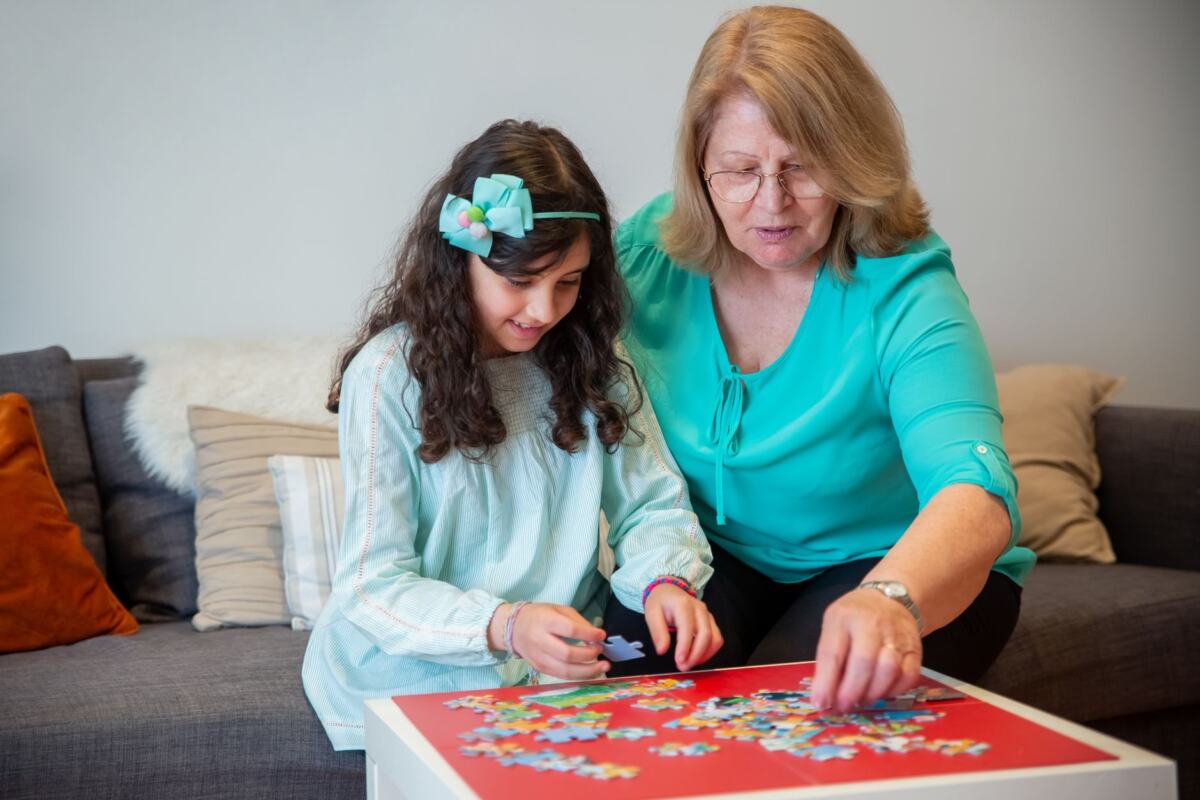
Puzzles suit a parent who liked order and pattern. ALZRA describes them as helpful for memory and reasoning, with difficulty running from basic puzzles that need little hand-eye coordination to more sophisticated ones that demand recall. Start at the easy end and move up only if your parent is enjoying it. A large-piece puzzle on a table you can both reach turns it into shared time as well as an exercise.
Board games and card games
Board games can aid memory, communication and emotional control, and card games can build reasoning, problem-solving, memory and concentration, according to the same guide. Card games suit a parent who already knows the rules and wants a familiar structure. Board games suit a family visit, because they give everyone something to talk about while playing. If your parent starts losing track of rules, simplify the game rather than abandoning it.
Games are not the only option, and not every parent enjoys them. Creative work is a good alternative.
Painting, drawing and other creative work
People with dementia can benefit from any artistic expression, and ALZRA lists painting and drawing among suitable art activities. The practical advantage is that art has no wrong answer. A parent who can no longer follow game rules can still choose a colour and make a mark.
Set out a few materials rather than a full box, and sit beside your parent instead of directing. Treat the process as the point. A finished picture is a bonus, so avoid correcting or critiquing it.
Music and music therapy
Music is the one activity that stays useful across nearly every stage. A UNC Greensboro kinesiology article on music therapy and Alzheimer’s disease defines music therapy as a clinical intervention that uses music to address physical, emotional, cognitive and social needs, with the aim of enhancing well-being and quality of life.
How music helps
Familiar songs from the past can help a person with dementia remember events, people and emotions from earlier in life. The same article says music can reduce anxiety, depression and agitation, which are common symptoms of dementia. Researchers are also studying music-evoked autobiographical memories, which are strong personal memories, often with emotional content, prompted by a song.

Making it work at home
Build a playlist from the music your parent loved when younger, not what you think is calming. Songs tied to a wedding, a job or a place are the most likely to prompt memories. Watch your parent’s face and posture. If a song brings comfort, repeat it. If it seems to unsettle them, skip it and note that for next time.
A trained music therapist offers a clinical approach, but a family playlist is a simple way to use the same idea in daily care.
Photos and reminiscing
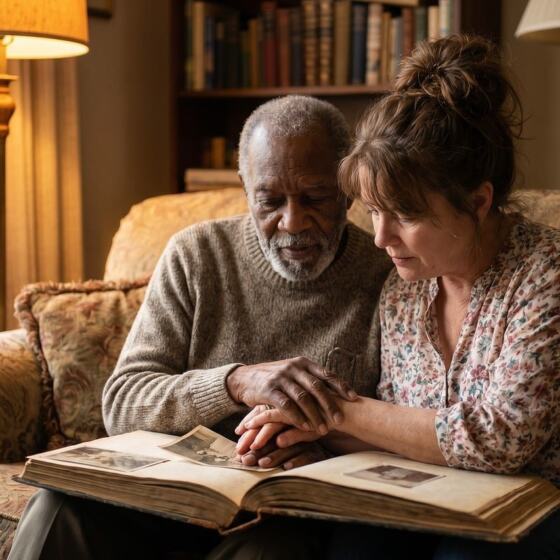
Reminiscence is useful because it asks for feelings and impressions, not exact recall. ALZRA suggests talking and reminiscing and looking at photos as simple activities, including for people with severe dementia.
Choose a few photos of faces and places from decades ago rather than a whole album. Ask open prompts such as “Tell me about this day” and accept whatever your parent says, even if details are muddled. Pairing a photo with a song from the same era combines two approaches that this guide has already covered.
Middle stage: familiar household tasks
As complex games become frustrating, everyday tasks can fill the gap. The aim is to give your parent a role with a clear, simple purpose.
- Folding laundry. Warm towels in a basket give a parent something to sort and fold at a table. It suits someone who ran a household and likes feeling useful.
- Setting out items. Placing napkins or cutlery gives a similar sense of purpose before meals.
- Sorting objects. Buttons, cards or socks by colour work well when a puzzle has become too hard.

Do not worry if the folding is not neat. Re-fold quietly later if you must, and avoid pointing out errors, since the task is about taking part, not the result.
Gardening and planting
Planting a flower in a pot suits a parent who liked gardens. Working at a table with soil, a pot and a plant keeps the activity contained and reduces the steps involved, so it stays manageable as concentration shortens.

Gardening outdoors is a pleasant option, but stay beside your parent, especially if they have started to leave home unexpectedly. Our guide to alzheimer’s wandering prevention covers that risk in more detail.
Late-stage dementia: sensory comfort and connection
In late-stage dementia, the goal shifts from doing to being with. ALZRA suggests talking and reminiscing, looking at photos and listening to music for severe dementia. It also cautions that some of the more complex activities may be too challenging at this point, so do not push games or crafts your parent can no longer follow.
What to try
- Familiar music. Play songs from earlier in your parent’s life, quietly, while sitting nearby.
- Photos and gentle talk. Hold a picture where it is easy to see and describe it in a calm voice. Your parent may not reply, and that is fine.
- Touch, if welcome. A gentle hand massage with lotion can be a calming moment of contact. Stop at once if your parent pulls away.

Short, quiet sessions are better than long ones. If daily support is becoming more than family can provide, our comparison of memory care vs assisted living explains the care settings available.
Adapting activities as abilities decline
Adapting is a matter of watching, not of following a calendar. Abilities vary from day to day, so an activity that worked last week may need to be simpler today. Use this checklist to decide.
- Start with what your parent enjoyed. A former cook may like sorting recipe cards, and a music lover will likely prefer songs to a puzzle.
- Choose the easiest version first. Pick a basic puzzle or a short game before a harder one, and move up only if it is going well.
- Watch for frustration. Sighing, pushing materials away or going quiet are signs to simplify or stop.
- Step down, do not stop. When a game becomes too hard, move to a task such as folding or sorting. When tasks become too hard, move to music, photos and talk.
- Keep sessions short and calm. Reduce noise and distractions and stay beside your parent.
- Review regularly. Notice what lights your parent up and keep that in the routine.
The pattern is consistent: the further the disease progresses, the more the activity should rely on feeling and sensation rather than skill or memory.
Frequently asked questions
Do board games protect against memory loss?
Some study findings link playing more analog games, such as board games, with less cognitive and memory decline from age 70 to 79, according to ALZRA. That is a link, not a guarantee, so play them because your parent enjoys them.
Does my parent have to sing or play an instrument for music to help?
No. Some people enjoy listening to music, while others prefer to sing or play an instrument. Listening to a familiar playlist is a perfectly good place to start.
What else can fill quiet time besides games and crafts?
Reading is a beneficial hobby that is not limited to books, and ALZRA also lists listening to the radio or watching television. Choose familiar, undemanding content that your parent finds easy to follow.
Is a family playlist the same as music therapy?
Not exactly. Music therapy is a clinical intervention that uses music to address physical, emotional, cognitive and social needs. A family playlist applies the same idea informally at home.